
Box breathing: a simple rhythm for when you’re in overdrive
Box breathing is a simple technique with four equal phases: inhale, hold, exhale, hold. This guide shows you how to practice it and how to choose the right interval - 3, 4, 5, or 6 seconds per phase.
When your system is running too fast
Sometimes you're "fine" on paper - but your body is already in a different gear. Thoughts bounce. Your jaw tightens. Your hands feel wired. Inside, there's a low-level buzz: plenty of energy, not much clarity.
It can hit mid-day, right before a meeting, at bedtime, or first thing in the morning when your brain starts boiling early. In those moments, complex advice rarely lands. You need something simple, memorable, and instantly actionable.
That's exactly where box breathing shines.
Box breathing (also called square breathing) is a four-phase pattern with equal timing: inhale - hold - exhale - hold.
It's called "box" because you move through four equal sides: same length, four steps, repeat.
Use it before a conversation, before sleep, or right in the middle of your day - whenever you feel your internal speed climbing.
Try it now: the 60-second reset
What to expect: not magic, just a small reset. For many people, the mind gets quieter and attention becomes easier to hold.
Sit upright or lean back with support. You can also do it lying down. Relax your shoulders.
- Inhale - 4 seconds. Nose or mouth, whatever feels natural.
- Hold - 4 seconds.
- Exhale - 4 seconds.
- Hold - 4 seconds.
Repeat 4 cycles (about one minute total).
One detail that matters: don't inhale to 100%. Breathe quietly at about 60-70%. Rhythm matters more than volume.
If it feels too intense, switch to 3-3-3-3. Same square, softer edges.
Where box breathing comes from
The idea behind box breathing is older than the name.
In yogic breathing traditions, there are practices built around equalized phases (inhale, hold, exhale, hold) - the same “square” logic that makes box breathing feel so clean and controllable.
The modern label "box breathing" (also often called tactical breathing) became popular because it's easy to remember under stress: four equal sides, four steps, repeat. Today, it's commonly taught as a practical self-regulation tool - simple enough to do anywhere, structured enough to calm the system quickly (Cleveland Clinic).
The core mechanism behind box breathing - slow, rhythmic breathing with brief breath holds - is supported by research on slow breathing and autonomic regulation. However, box breathing as a specific equal-phase protocol (inhale / hold / exhale / hold) has not been tested in large randomized controlled trials. In a 2025 head-to-head comparison, box breathing showed a smaller acute HRV increase than coherent breathing or 6 breaths/min pacing in the same sample. Effects are real but the direct evidence base for this specific protocol is thinner than for slow breathing in general.
How Brizzy labels evidence →What the Stanford study suggests
In 2023, a randomized study compared 28 days of short daily practices: mindfulness meditation and three types of breathwork (cyclic sighing, box breathing, and cyclic hyperventilation with retention). The point wasn't only what "works," but what people can realistically stick to daily (Cell Reports Medicine).
In the study's optional post-study debrief (not everyone responded), box breathing was often rated as highly manageable to do daily. Respondents also frequently described it with words like calming and focusing.
Debrief respondents only.
Daily ease: how manageable did it feel to do every day?
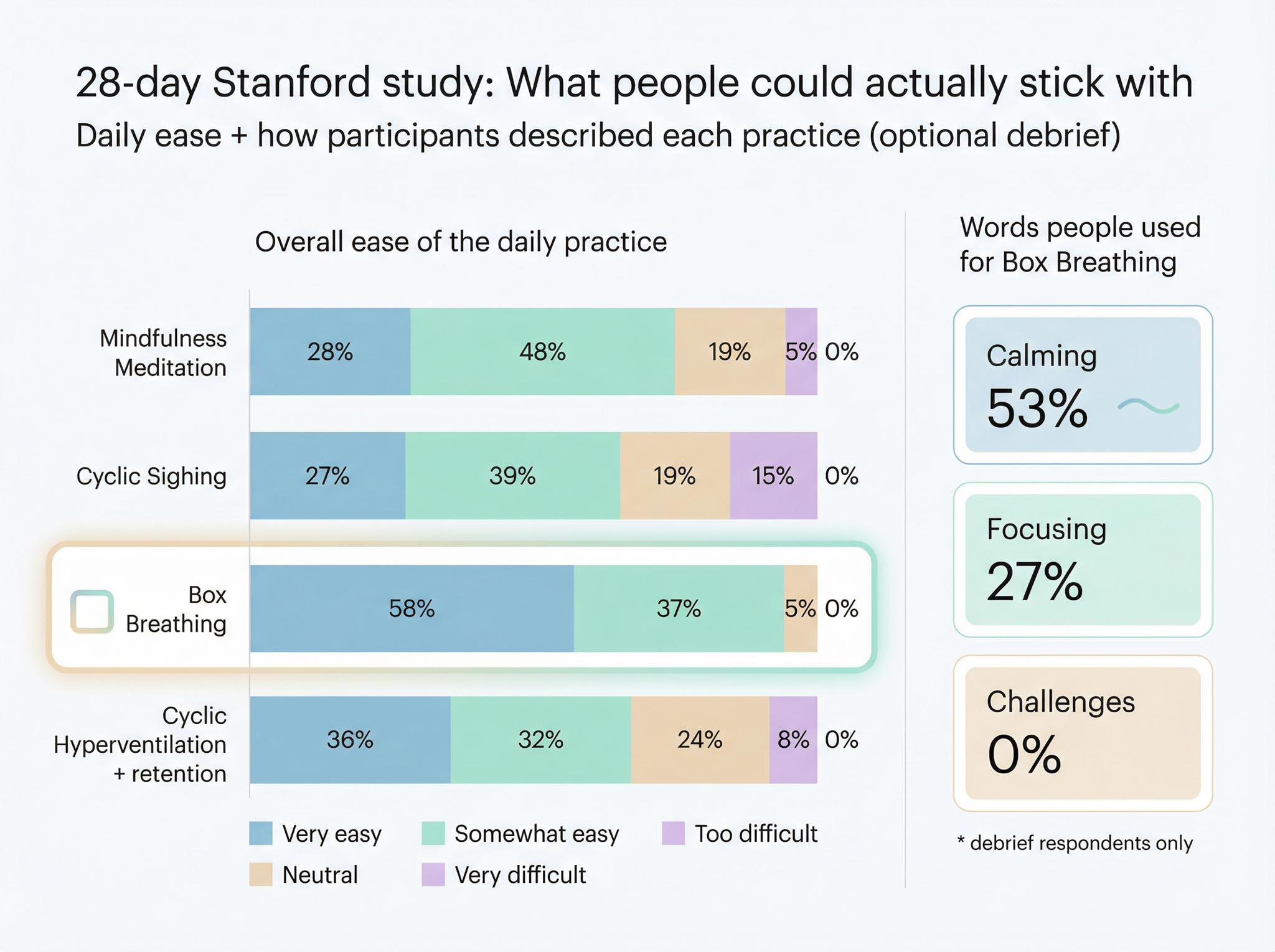
Comparison of daily-practice ease in a 28-day study (~5 minutes/day). In the optional debrief, box breathing was most often rated "very easy" (58%) and described as "calming" (53%) and "focusing" (27%). Debrief respondents only.
Balban et al., Cell Reports Medicine (2023), optional post-study debrief (ease of daily practice + Table S2).
Why it works
Box breathing works through two simple mechanisms: self-regulation and attention.
First, you give your nervous system a clear signal through the body: "I control the rhythm." Equal phases and pauses reduce internal noise and help slow the stress response.
Second, you automatically sharpen focus because you track a pattern. Counting 1-2-3-4 is a small task, but it anchors awareness and leaves less fuel for racing thoughts. That's why box breathing can do two things at once: it calms you down and pulls you together.
Think of it as a short reset you can carry anywhere.
Box breathing tempos: 3, 4, 5, or 6
The standard is 4-4-4-4. The power of this technique is that you can easily adjust it to your state.
3-3-3-3: the soft start
If 4-second holds feel uncomfortable or tight, start with 3 seconds in each phase. Same square, gentler.
4-4-4-4: the default you can remember
Inhale 4 - hold 4 - exhale 4 - hold 4. Easy to use before a meeting, between tasks, or whenever you need to steady yourself.
5-5-5-5: slower and steadier
If 4 seconds feels comfortable, try 5-5-5-5. The rhythm slows down, attention is easier to hold, and many people describe it as a more even mode.
6-6-6-6: deeper pace
6-6-6-6 is the same square with longer phases. If it stays soft and controlled, it often feels more calming. If it feels pressuring, step back.
As the "side" gets longer, breathing gets slower and you do fewer cycles per minute. Many people experience 4-4-4-4 as control, 5-5-5-5 as steady, and 6-6-6-6 as more relaxing. There is no "correct" number. Box breathing only works when the intervals feel manageable without strain.
How to choose your interval
Start with 4-4-4-4 and do 4 cycles. That's your baseline.
- If holds create tension or you feel like you need to "grab" air, switch to 3-3-3-3.
- If 4-4-4-4 feels easy and you want a slower pace, move to 5-5-5-5.
- If 5-5-5-5 is also comfortable, you can try 6-6-6-6, but only if it stays soft.
Golden rule: your best interval is the one where you can do 4 cycles quietly, evenly, and without forcing the breath.
Time: for most people, 5 minutes a day is enough to understand whether this technique fits.
Quick reference: 3 vs 4 vs 5 vs 6
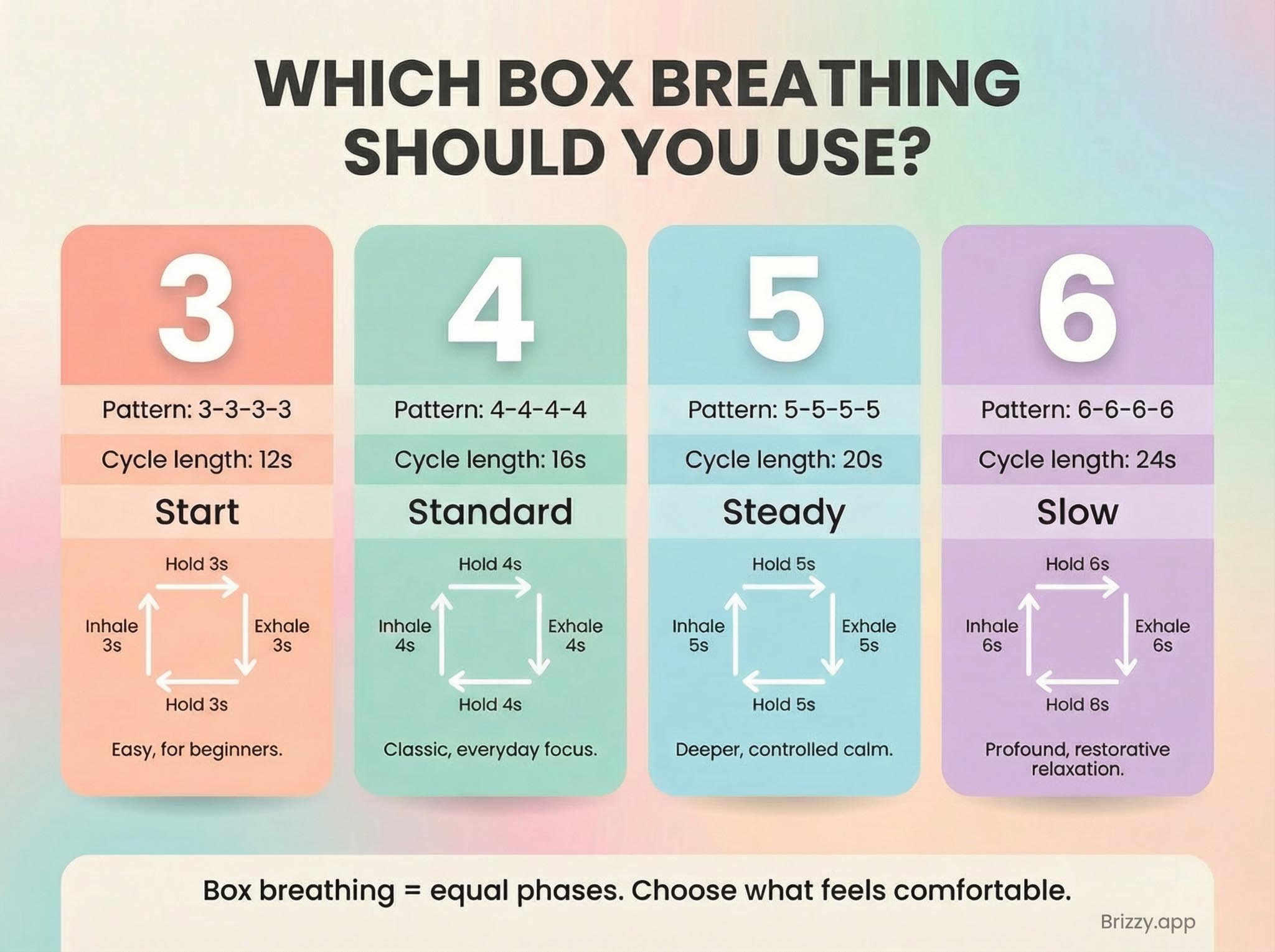
Box breathing cheat sheet: every phase is equal. Only the "side length" changes (3/4/5/6 seconds). Choose the tempo that feels controlled and comfortable.
Make it work in real life
Common mistakes and quick fixes
- Too big of an inhale. Keep it quiet - about 60-70% of your max. Rhythm matters more than volume.
- Forcing the inhale or exhale. Shorten the interval and soften the breath.
- The holds feel pressuring. That's a sign the tempo is too long - drop back to 3 or 4.
- You lose the count and get annoyed. Don't chase numbers. Just restart on the next inhale.
- Doing it where you need full attention. Don't practice while driving, in water, or around machinery.
When to use it: five everyday situations
- Before a difficult conversation or meeting - to lower internal noise and get steady.
- Between tasks - a clean attention reset when thoughts bounce.
- After coffee, news, or stress - to bring the body back into a controlled rhythm.
- Before sleep - if your mind keeps spinning.
- During a wave of anxiety - counting + rhythm gives you a simple anchor in the moment.
Safety and comfort
Box breathing should feel controlled and calm. Stop or shorten the interval if:
- you feel dizzy, nauseous, or sharply uncomfortable;
- you feel like you have to gasp or force the breath;
- anxiety increases (in that case, return to 3-3-3-3 or normal relaxed breathing).
FAQ
Can I do box breathing before sleep?
Yes. Many people prefer slower intervals at night, but comfort comes first. If holds feel pressuring, shorten the count.
Nose or mouth?
Either. Quiet nasal breathing often feels calmer for many people, but the core of the technique is the rhythm, not the route.
How many minutes per day is enough?
For many people, 5 minutes is enough to feel a difference and build the habit. Short and consistent beats perfect.
How fast should it work?
Sometimes you feel a shift within 1-2 minutes. The deeper value comes from repetition - your body starts recognizing the pattern.
What if I get dizzy?
Stop and return to normal breathing. Next time, use a smaller interval (3-3-3-3) and keep the inhale gentler.
Why are the holds hard for me?
Most often the interval is too long or your inhales are too deep. Shorten the count and keep the breath quieter.
How is box breathing different from other techniques?
Box breathing uses equal phases (a square). It's predictable, simple, and works well as a baseline self-regulation tool.
Can I practice this online?
Yes, try our free guided box breathing session which includes audio cues and visual pacers to help you maintain the rhythm.
References
Try it in Brizzy
If you want to practice without counting in your head, Brizzy includes box breathing with 3, 4, 5, and 6-second intervals, plus session lengths you can choose: short, medium, or long. Everything from this article can be tested immediately.