
Coherent breathing: how a slow, even rhythm may improve HRV during practice
Learn how to do coherent breathing at about 5 to 6 breaths per minute, why it may improve HRV during practice, and where the evidence for stress, blood pressure, and sleep is strong or mixed.
When your system needs maintenance, not a jolt
Some moments call for a sharp reset - a structured pause to interrupt a spiral. Other moments call for something quieter: not a jolt, but a slow, even current your nervous system can settle into.
That is where coherent breathing fits. It does not ask you to hold your breath or chase complex counts. It asks you to find a rhythm - smooth in, smooth out - and keep it long enough for your body to notice.
Most people are taught to breathe at around 5 to 6 breaths per minute: roughly 5 seconds in, 5 seconds out. No holds. No forcing. Just continuity.
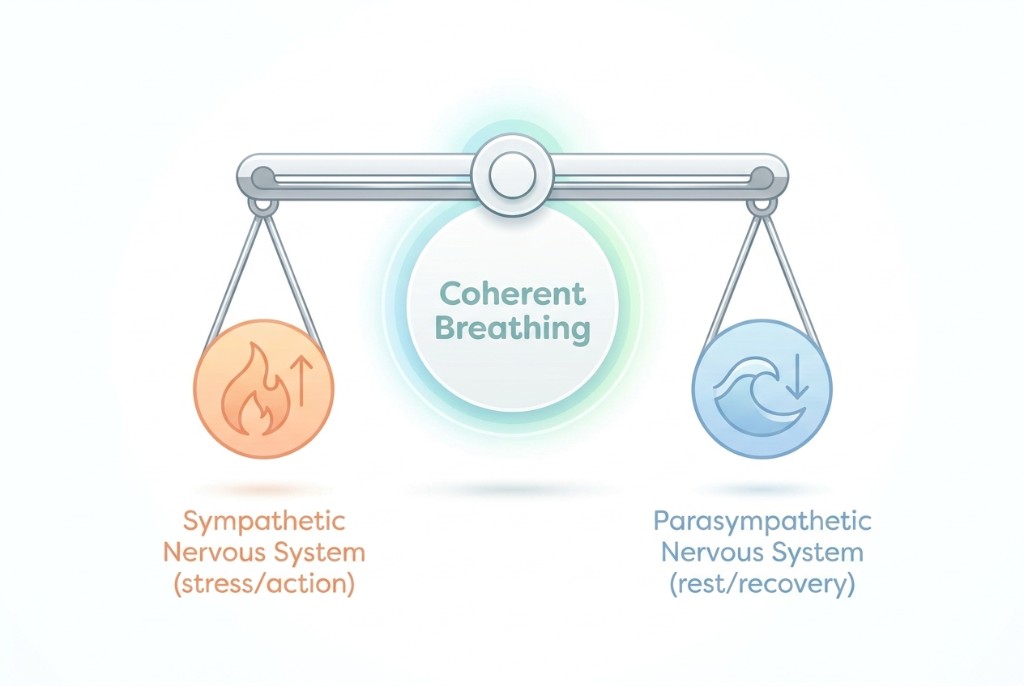
Coherent breathing acts as a steadying force, helping to balance the sympathetic (alert) and parasympathetic (calm) branches of the autonomic nervous system without the jolt of breath holds.
Try it now: a 10-minute friendly start
What to expect: not a dramatic switch for everyone - more like a steadier internal tempo. Some people feel calmer quickly; others mostly notice subtle changes over repeated sessions.
Sit or lie comfortably. Relax your shoulders.
- Inhale - about 5 seconds. Nose is typical; keep it smooth, not a gulp.
- Exhale - about 5 seconds. Nose or mouth - whatever feels soft.
- No pauses at the top or bottom - let the breath roll like a slow wave.
- Repeat for 5 to 20 minutes (start with 10 minutes if that feels realistic).
One detail that matters: this is not “maximum depth” breathing. Keep the breath quiet and even - rhythm beats volume.
If the pace feels forced, slow down the mental demand first: try 4 seconds in / 4 seconds out, then lengthen as it stays easy.
Real-world practice: the 20-minute shift
In a conversation on the Huberman Lab podcast (Rick Rubin: Protocols to Access Creative Energy and Process, 2023), legendary music producer Rick Rubin discussed using slow-paced breathing specifically to improve his Heart Rate Variability (HRV).
A few practical takeaways from his experience align perfectly with the clinical research:
- Dosing matters: Rubin noted that while 10 minutes is a solid baseline, extending the practice to 20 minutes produced a much more noticeable jump in his HRV metrics.
- Anchoring the mind: To keep his mind from wandering during longer sessions, he counts the seconds. The counting isn't just for pacing; it gives the brain a simple "job" to do, reducing distracting thoughts.
- Context: He often uses the practice after physical stress (like being in the water or sun) to ground his system back to baseline.
Where coherent breathing comes from
The modern consumer label coherent breathing is often associated with Stephen Elliott, who popularized a simple, even-paced practice aimed at nervous-system regulation.
In research, you will rarely see the marketing name on a lab handout. Scientists usually study overlapping ideas under terms like slow-paced breathing, resonance-frequency breathing, and HRV biofeedback - different packaging, similar family of protocols.
The mechanisms behind coherent breathing - slow pacing near resonance frequency, vagally mediated HRV increase - are well-supported by a 2022 meta-analysis of 223 studies (Laborde et al.). However, a 2023 placebo-controlled RCT with 400 participants found that coherent breathing did not outperform a matched breathing placebo on stress, anxiety, depression, or wellbeing outcomes. The acute HRV effect during practice is well-documented; the claim that this specific rhythm is uniquely therapeutic beyond other slow breathing patterns is not settled.
How Brizzy labels evidence →What the research suggests
The literature closest to coherent breathing is broad. Three themes show up again and again: HRV during practice, blood pressure (often modest, uneven effects), and stress / sleep (often mixed, depending on the comparison and outcomes).
HRV and autonomic regulation - relatively strong during practice
A 2022 meta-analysis by Laborde and colleagues, drawing on 223 studies, reported that slow-paced breathing was associated with increased vagally mediated HRV - both during sessions and immediately after (Laborde et al., 2022).
A 2025 acute comparison in college students found breathing at 6 breaths per minute increased HRV more acutely than box breathing or 4-7-8 in that sample (Marchant et al., 2025).
Taken together, coherent breathing is one of the better-supported breathing patterns for increasing HRV during the practice itself - which is different from claiming any single pace is “best” for everyone, forever.
Blood pressure - promising, but uneven
Several systematic reviews and meta-analyses suggest slow breathing may help lower blood pressure modestly in some people, with effects often looking more pronounced in some clinical populations than in healthy samples. A 2019 systematic review and meta-analysis reported pooled reductions on the order of a few mmHg for some slow-breathing interventions (Chaddha et al., 2019).
Calibration: coherent breathing is not a substitute for medical management. If your blood pressure is a medical concern, treat this as a supportive habit alongside clinician guidance - not a replacement.
Stress and anxiety - honest mixed evidence (including a major placebo-controlled trial)
Broader breathwork research can look encouraging in summaries - but summaries hide important design details.
The most directly relevant placebo-controlled coherent-breathing trial published in 2023 followed 400 participants (~5.5 breaths per minute, ~10 minutes per day, four weeks) and did not show that coherent breathing outperformed a matched breathing placebo on stress, anxiety, depression, or wellbeing (Fincham, Strauss & Cavanagh, 2023).
What that means in plain language: many people feel calmer with slow breathing - but the “specialness” of this exact pace versus other credible breathing routines is not settled by that trial. Do not overclaim specificity.
Sleep - subjective improvements more consistent than objective
A 2026 systematic review of slow breathing before bedtime (9 studies, 457 participants) reported that subjective sleep duration and quality were more consistently improved than objective measures from actigraphy and polysomnography (Eide, Hernes & Grønli, 2026).
Calibration: coherent breathing may help some people unwind before bed and report sleeping better. It is not a clinically established standalone treatment for chronic insomnia.
Why it works (the physiology in one pass)
At rest, many adults breathe faster than 5 to 6 breaths per minute. Slowing toward that range - near about 0.1 Hz - moves you into a physiologically interesting zone where breathing, heart rate, and blood pressure oscillations can couple more strongly.
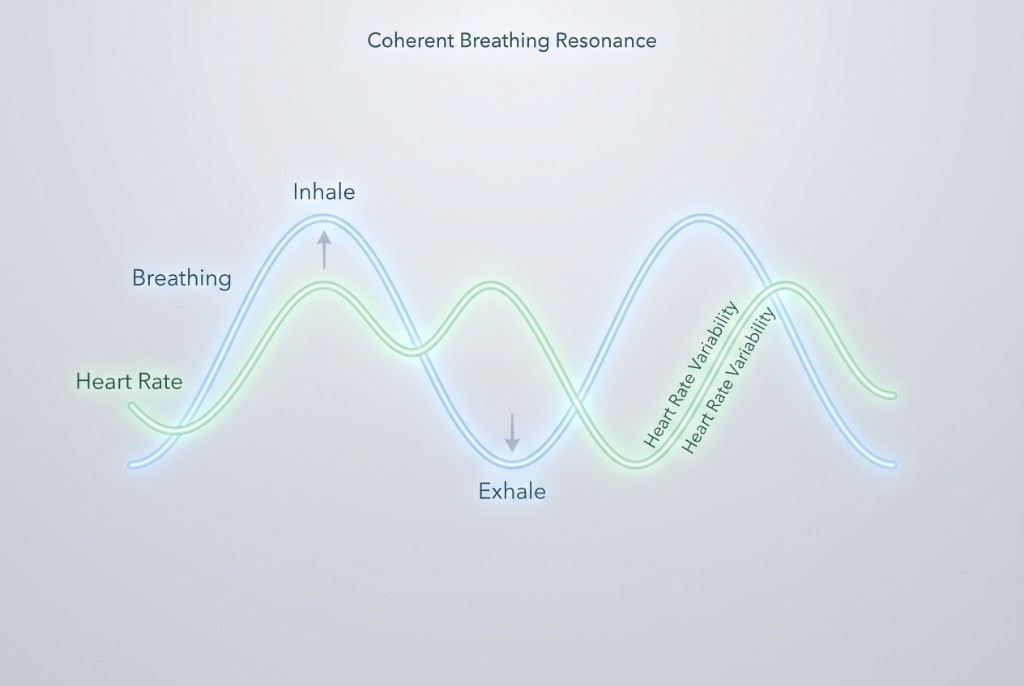
When you breathe at your resonance frequency (usually around 5.5 breaths per minute), your breathing and heart rate oscillations align, maximizing respiratory sinus arrhythmia (RSA).
Researchers describe a resonance effect: breathing oscillations line up with cardiovascular rhythms in a way that can amplify respiratory sinus arrhythmia (RSA) - the natural heart-rate rise on inhale and fall on exhale - and support metrics related to baroreflex sensitivity and vagally mediated HRV.
The exact resonance point varies between people. Some people land closer to 4.5 breaths per minute; others closer to 6.5. 5.5 seconds in and 5.5 seconds out is a common consumer default - a useful starting line, not a universal prescription.
Coherent breathing tempos: 5-5, 5.5-5.5, 6-6
The “standard idea” is an even inhale and exhale - same length - without holds.
5-5: the simple baseline
5 seconds in / 5 seconds out is easy to explain and easy to practice. If you want a clean starting tempo, start here.
5.5-5.5: a common default in apps and teaching
5.5 seconds in / 5.5 seconds out is a well-worn consumer default. It is useful - not because everyone matches it perfectly, but because it nudges many people toward the slow range without requiring perfection.
6-6: slightly slower, still even
6 seconds in / 6 seconds out is the same pattern with a softer cadence. If it feels smooth and unforced, it can be a good fit - especially if shorter intervals feel rushed.
If any tempo creates air hunger, dizziness, or strain, shorten the seconds and soften the breath.
How to choose your pace
Start with 5-5 or 5.5-5.5 for 10 minutes. That is long enough to feel the rhythm without turning it into a performance.
- If you feel breathless, dizzy, or tense, drop to 4-4 and keep the breath smaller.
- If the pace feels easy and almost boring, you can experiment with 6-6 - but only if it stays soft.
Golden rule: your best tempo is the one you can sustain without forcing depth and without pausing the continuity.
Coherent breathing vs box breathing
Both are slow, paced tools - but they solve slightly different jobs.
| Feature | Coherent Breathing | Box Breathing |
|---|---|---|
| Pattern | Continuous (e.g., 5.5 in, 5.5 out) | Structured (e.g., 4 in, 4 hold, 4 out, 4 hold) |
| Holds | None (smooth wave) | Two holds per cycle (square) |
| Primary Goal | Maintenance, HRV training, balance | Tactical reset, acute stress interruption |
| Best For | Daily 10-20 min practice, wind-down | Pre-meeting, panic moments, quick focus |
Box breathing uses a deliberate structure: inhale, hold, exhale, hold - equal phases in the classic form. The holds add a crisp interruption that many people find useful when they need a tactical reset in a hot moment.
Coherent breathing is continuous. No holds. The point is to sustain a smooth oscillation long enough for your system to settle - more like maintenance than a sharp puncture.
Box breathing is often for interrupting. Coherent breathing is often for maintaining.
Make it work in real life
Common mistakes and quick fixes
- Forcing a “big” breath. Coherent breathing is not maximum lung volume. Forced slow breathing can trigger lightheadedness, tingling, or air hunger. Keep the breath small-to-medium and smooth.
- Chasing perfect seconds. The resonance zone is a band, not one metronome setting. Adjust until the rhythm feels sustainable.
- Expecting an instant mood miracle. Acute HRV changes can show up quickly in research contexts; subjective calm varies person to person - and placebo-controlled trials remind us not to overclaim specificity.
- Doing it where you need full attention. Do not practice while driving, in water, or around machinery.
When to use it
- Daily regulation: 10 to 20 minutes most days, if that fits your life.
- Wind-down: 5 to 10 minutes before sleep as part of a routine (subjective sleep benefits are more consistent than objective measures in reviews).
- Between tasks: a few minutes to return to a steadier baseline - especially when you do not want holds.
Safety and comfort
Coherent breathing should feel smooth and sustainable. Stop or shorten the tempo if:
- you feel dizzy, nauseous, or sharply uncomfortable;
- you feel air hunger or need to gasp;
- anxiety spikes (return to normal relaxed breathing).
If you have asthma, COPD, significant cardiovascular disease, or you are unsure, ask a clinician before treating this as a primary intervention.
FAQ
What is coherent breathing?
Coherent breathing is a slow-paced breathing practice typically taught at around 5 to 6 breaths per minute - roughly 5 seconds in and 5 seconds out - with no breath holds and no forced depth. In research, similar protocols are studied under names including slow-paced breathing, resonance-frequency breathing, and HRV biofeedback.
What is the difference between coherent breathing and resonance breathing?
The terms are often used interchangeably. Resonance-frequency breathing refers more specifically to the physiological phenomenon: breathing near the rate that amplifies oscillations, typically around 4.5 to 6.5 breaths per minute. Coherent breathing is a consumer-facing label for a similar practice, associated with teacher Stephen Elliott.
Does coherent breathing really improve HRV?
During practice, yes - increased vagally mediated HRV is among the better-supported acute outcomes in the slow-breathing literature. Whether changes persist long-term outside sessions depends on how regularly you practice and on individual factors.
How long should a coherent breathing session be?
Most research protocols use 5 to 20 minutes. Ten minutes is a practical starting point that shows up often in studies and in daily life.
Can I use coherent breathing for sleep?
Many people find it useful before bed. Evidence for improved subjective sleep is generally more consistent than objective improvements on actigraphy or polysomnography. A short 5 to 10 minute practice as part of a wind-down routine is a reasonable place to start.
Is coherent breathing safe?
For many healthy adults, it is among the gentler breathwork practices. The main risk is overbreathing if you force depth or pace. Stop if you feel dizzy, air hunger, or distress. If you have a respiratory or cardiovascular condition, ask a clinician first.
Do I need a timer?
It helps. Counting an even pace precisely in your head is hard. A visual pacer or audio guide (like in Brizzy) makes it easier to lock into the rhythm without tensing around the numbers.
Can I do coherent breathing with my eyes open?
Yes. While many people (including music producer Rick Rubin) prefer closing their eyes to focus inward, the technique is entirely adaptable. You can practice with eyes open during a commute, at your desk, or while walking.
Can I practice this online?
Yes, try our free guided coherent breathing session which includes audio cues and visual pacers to help you maintain the rhythm.
References
Russo, M. A., Santarelli, D. M., & O'Rourke, D. (2017). "The physiological effects of slow breathing in the healthy human." Breathe.
Laborde, S., et al. (2022). "Influence of slow-paced breathing on cardiac vagal activity: a meta-analysis." Neuroscience & Biobehavioral Reviews.
Marchant, J., Khazan, I., Cressman, M., & Steffen, P. (2025). "Acute comparison of 6 breaths/min vs square breathing vs 4-7-8." Applied Psychophysiology and Biofeedback.
Chaddha, A., et al. (2019). "Device- and nondevice-guided slow breathing to reduce blood pressure: systematic review and meta-analysis." Complementary Therapies in Medicine.
Fincham, G. W., Strauss, C., & Cavanagh, K. (2023). "Effect of coherent breathing on mental health and wellbeing: a randomised placebo-controlled trial." Scientific Reports.
Eide, E. M., Hernes, H. M., & Grønli, J. (2026). "Slow breathing before bedtime: a systematic review." Sleep Medicine Reviews.
Try it in Brizzy
If you want to practice without micromanaging seconds in your head, Brizzy includes coherent breathing with pacing support so you can keep an even, continuous rhythm - the same habit the article describes, tested in a guided session.