

Freediving
Build a calm, longer static hold - the foundation under every dive you'll ever make.

Not fixed tables from the internet - one short test, and every CO2 and O2 session is calculated from your own result, with the same safety principles freedivers train by.
A longer, calmer breath-hold is the quiet superpower behind everything you do at sea.
Build a calm, longer static hold - the foundation under every dive you'll ever make.

Relaxed bottom time starts on dry land, not at depth. Train the urge before it trains you.
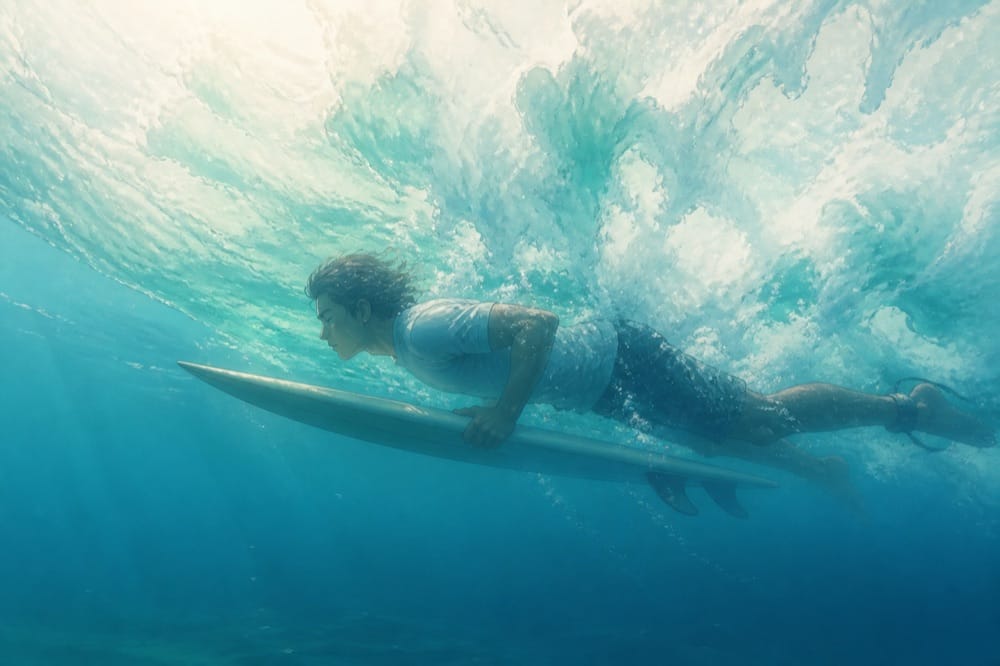
Real hold-downs rarely last beyond 12-15 seconds. Train your calm so the urge to breathe becomes an old friend, not a panic trigger.
Four building blocks, in the order your body actually learns them.
Find your comfortable baseline - a short, guided test with zero pressure.
Get used to the urge to breathe. Same hold, shorter rests - your tolerance grows.
Extend your hold, gradually. Longer holds, full rests - never a race.
Return to calm after every hold with guided hook-recovery breaths (Fernandez et al.) to safely restore oxygen levels.
Watch your capacity grow over weeks of practice. Alternate CO2 and O2 days in a structured rhythm, never guessing what to do next.
Real seconds from your own test - not numbers someone guessed for everyone.
CO2 and O2 sessions recalculate automatically as your hold improves.
Every session ends with guided hook recovery (Fernandez 2019) - the habit that keeps you safe.
Calculated from your 1:52 baseline - never someone else's.

At Brizzy we believe every breathing practice is worth taking seriously - and breath-holding is one of the most requested, most misunderstood of them all. Almost everything online is a fixed table "for everyone", with no idea of your real level.
So we made it personal and safe: dry practice only, built on your measured maximum, with the same evidence-first approach as the rest of Brizzy. No hyperventilation, stop the moment it feels off.
It turns Brizzy from a breathing app into a real training companion for the ocean.
Breath-hold training is safe when it respects a few hard lines. We built them into every session.
Every session in the app is dry practice - sitting or lying down, never in water.
We never use fast over-breathing to fake a longer hold - it silences the very signal that keeps you safe.
Tables scale from your measured level, never someone else's. Stop the moment it feels off.
What you train here is for the ocean, but in-water practice always needs a buddy and proper supervision.
Apnea is a voluntary breath-hold. Training it means teaching your body to stay calm without air for longer - through structured hold-and-rest sessions called CO2 and O2 tables. Freedivers, spearfishers, and surfers have trained this way for decades.
CO2 tables keep the hold time the same but gradually shorten your rest time. This trains your tolerance to the urge to breathe (caused by rising carbon dioxide). O2 tables give you full rest between holds but gradually increase the hold time, pushing your absolute capacity (lowering oxygen). You need both.
Yes, provided it is done dry (sitting or lying down on a bed or sofa), never in the water. Dry practice is where you safely build capacity. If you pass out on a sofa, you just start breathing again. In water, you always need a trained buddy.
Dry-land breath-hold training at a comfortable level is considered low-risk for healthy adults. Brizzy keeps it that way: no hyperventilation, tables scaled to your measured baseline, and guided recovery after every hold. If you have a heart or respiratory condition, or are pregnant, talk to a doctor first.
No - every session in Brizzy is dry practice, sitting or lying down. That's where breath-hold capacity is actually built. The water is where you'll enjoy it, always with a buddy.
Most beginners see rapid improvement within the first two weeks, mostly from learning to stay calm, not from growing larger lungs. The Massini et al. (2023) meta-analysis confirms that training reliably lengthens breath-holds, while individual trials report gains from 15% up to 60% in the first weeks. Brizzy re-tests your baseline as you go, so your tables grow with you.
Dose and improvement: Massini et al. (2023) meta-analysis confirms the general training effect of breath-holds, while other individual trials in the field document specific gains over weeks of practice.
Safety and recovery: Fernandez et al. (2019) on hook recovery protocols to safely restore oxygen saturation post-apnea.
Tables vs maximal holds: Declercq et al. (2024) found that structured tables present a milder physiological stimulus than maximal holds. While the authors recommend maximal holds for faster adaptation in sport, Brizzy uses tables specifically because they are the milder, safer stimulus for everyday practice.
Start on dry land today. The water will feel different next time.